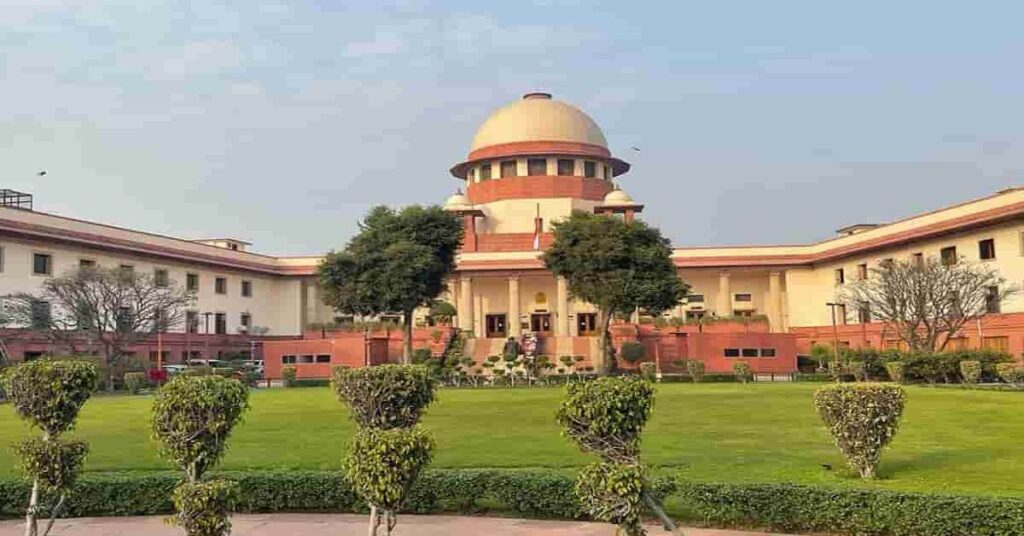
In a major development, the Supreme Court of India signaled on Wednesday that it may invalidate Talaq-e-Hasan, a form of Muslim divorce, raising pointed questions about its relevance in modern society. A three-judge bench, comprising Justices Surya Kant, Ujjal Bhuyan, and N. Kotiswar Singh, suggested the case might require a full five-judge Constitution Bench to resolve fundamental constitutional issues.
What Is Talaq-e-Hasan?
Talaq-e-Hasan is a traditional form of divorce under Muslim personal law in which a husband pronounces “talaq” once a month over three consecutive months. If reconciliation fails and cohabitation does not resume by the third pronouncement, the divorce becomes final and irrevocable.
Unlike the “instant” triple talaq (Talaq-e-Biddat), which was struck down by the Supreme Court in 2017, Talaq-e-Hasan allows for a period of reflection and reconciliation between pronouncements.
Why the Court Is Taking It Up Now
The court heard a Public Interest Litigation (PIL) filed in 2022 by journalist Benazeer Heena, who argues that Talaq-e-Hasan is unconstitutional, discriminatory, and violates several fundamental rights guaranteed by the Indian Constitution including the rights to equality (Article 14), non-discrimination (Article 15), dignity (Article 21), and freedom of religion (Article 25).
In response, the bench asked all parties to submit detailed notes outlining the key legal questions to be addressed. The court also invited input from national bodies, directing the National Commission for Women (NCW), National Human Rights Commission (NHRC), and National Commission for Protection of Child Rights (NCPCR) to provide their opinions.
The Bench’s Stark Observations
During oral remarks, Justice Kant posed sharp criticisms of the practice’s continuing acceptance:
“What kind of thing is this? How are you promoting this in 2025?” he asked, emphasizing that the court must examine whether such a practice upholds the dignity of women in a modern, civilised society.
He added that “if there are gross discriminatory practices, then the court has to interfere,” signaling judicial willingness to intervene in deeply rooted religious or personal law practices that may run counter to constitutional values.
Besides, the bench showed concern that while Heena, as a journalist, had the resources and awareness to approach the Supreme Court, many women from vulnerable or disadvantaged communities may be silently suffering without such access.
Timeline and Next Steps
The court has listed the matter for further hearing on November 26, 2025, giving parties an opportunity to submit the required briefs.
The final hearing for a batch of petitions challenging Talaq-e-Hasan is scheduled for November 19–20.
If the court does refer the matter to a five-judge Constitution Bench, it would mean a far-reaching judicial review, likely touching on the intersection of religious freedom, gender justice, and constitutional morality.
Potential Implications
1. Legal Precedent: A ruling to abrogate Talaq-e-Hasan could set a landmark precedent, further reforming personal laws to align more closely with constitutional principles.
2. Gender Justice: It could address long-standing concerns that this divorce mechanism disproportionately disadvantages women, limiting their agency.
3. Social Backlash: Any change to religiously sanctioned practices often invites passionate debate and resistance from conservative quarters; navigating that carefully will be a challenge.
4. Policy Reform: A judgment could prompt the government to consider gender-neutral and religion-neutral divorce laws, pushing for reform in the broader framework of family law.
Voices on Both Sides
Supporters of Abolition argue that Talaq-e-Hasan, while more “thoughtful” than instant triple talaq, still enables a unilateral, extrajudicial divorce, which they see as inherently unequal.
Defenders of the practice counter that it is a religiously legitimate form of divorce, rooted in Islamic jurisprudence, and comes with built-in periods for reconciliation.
Conclusion
The Supreme Court’s strong language asking if a “civilised society” should still permit Talaq-e-Hasan signals that this case could be about more than just a procedural challenge. It could mark a turning point in how personal laws are reconciled with India’s constitutional commitments to equality, dignity, and non-discrimination. As the court moves closer to possibly constituting a Constitution Bench, all eyes will be on what could be a historic ruling.