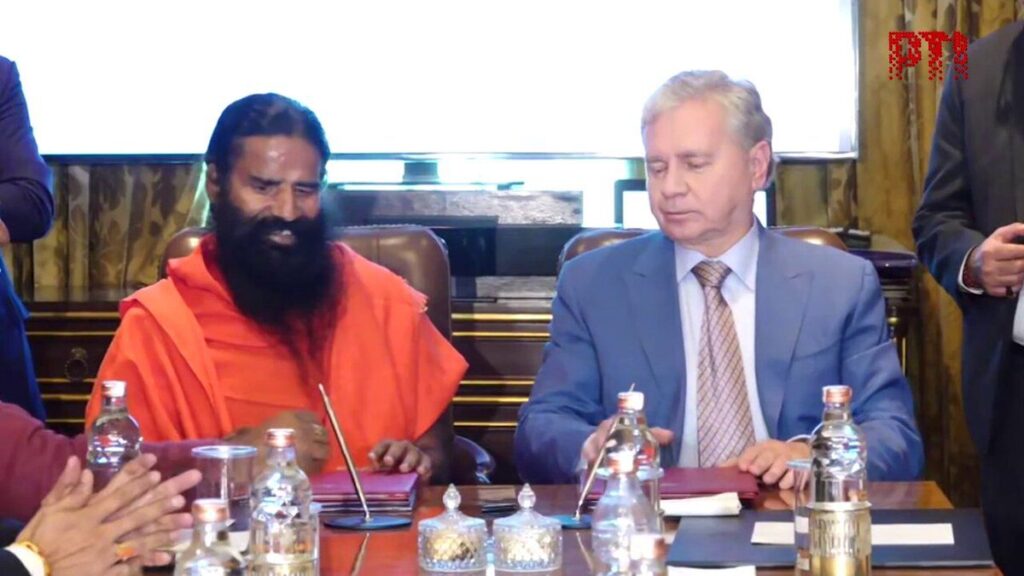
Patanjali Group has signed a memorandum of understanding with the Government of Moscow to provide trained personnel and wellness related services as part of a wider push to deepen India Russia cooperation in trade health and cultural exchange. The agreement was formalised during recent high level exchanges between Indian and Moscow officials and leaders from Patanjali Yogpeeth.
According to official notes and public postings about the meeting the pact frames collaboration in two broad areas. First it sets out pathways for the training certification and deployment of skilled workers from India for roles Moscow has identified as priorities. Second it creates a platform for Patanjali to deliver wellness programs based on yoga Ayurveda and naturopathy and to support wellness centres clinics and public outreach in Moscow and surrounding regions.
The visit of a Moscow delegation led by Sergey Cheremin minister of the Moscow government helped pave the way for the agreement. The delegation has been engaged in discussions aimed at expanding bilateral trade investment and people to people links with India. Public images and posts linked to the meetings show senior Patanjali figures including Yoga Guru Swami Ramdev and Acharya Balkrishna taking part in the ceremonies and discussions.
Patanjali leaders have been active on multiple fronts internationally this year. Acharya Balkrishna represented Patanjali and India at large scale cultural events in Moscow where India was the guest of honour. Those engagements underscored Patanjali’s strategy of blending cultural diplomacy with business outreach as it expands services and health care offerings outside India.
The agreement is framed as a non exclusive cooperation document that will guide concrete projects over the coming months. Key components reported by parties include
• A training and certification program for Indian wellness and allied health professionals so they can meet Russian licensing and workplace requirements
• Pilot wellness centres offering yoga Ayurveda and naturopathy based consultations workshops and community programs in Moscow
• Exchange of know how on public wellness campaigns workplace health and preventive medicine
• A joint working group to identify labour needs in specific sectors and to design recruitment and placement pathways.
Officials and independent observers say the MoU leverages two complementary trends. Moscow is seeking practical partnerships to fill skill gaps and to broaden public health options while Indian wellness providers are expanding overseas as demand for integrative health and lifestyle services grows. The arrangement is consistent with recent India Russia efforts to boost cooperation across trade technology and health.
While the new pact points to practical cooperation media commentary and official responses in recent months show Moscow remains cautious about large scale recruitment drives from any single country. Russia’s federal labour ministry has in the past denied that it planned mass recruitment of foreign workers on the scale sometimes reported in social media. Observers say successful implementation of the Patanjali Moscow MoU will depend on clear regulatory roadmaps professional certification processes and transparent recruitment safeguards.
The MoU is expected to move next to project level planning. Both sides have indicated they will form technical teams to map out pilot locations professional training curricula and time lines for pilot wellness centres and labour mobility pilots. If successful the model could be extended to other Russian regions and to additional areas of health and education cooperation.
The Patanjali Moscow MoU brings together an Indian wellness house with a city government that is actively seeking new partnerships in health labour and cultural exchange. The pact is an example of the soft power and commerce mix shaping recent India Russia ties and it will be watched closely for how quickly pilot projects translate into people to people outcomes on the ground.