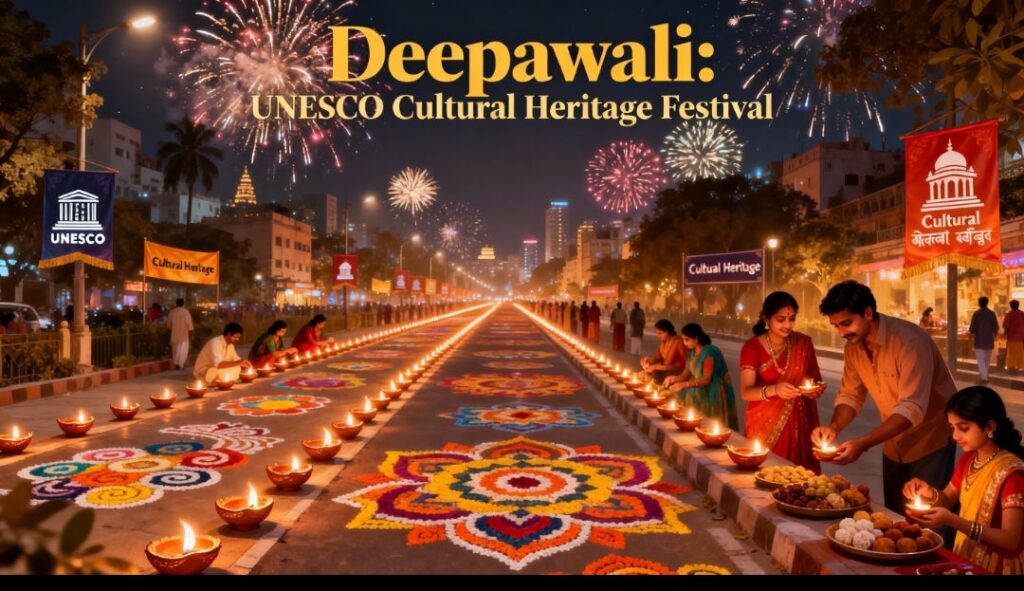
In a landmark decision that underscores the global significance of India’s cultural heritage, Deepavali, the Festival of Lights has been officially added to the UNESCO Representative List of the Intangible Cultural Heritage of Humanity. The announcement was made on Wednesday during the 20th session of the Intergovernmental Committee for the Safeguarding of Intangible Cultural Heritage (ICH), being held at the historic Red Fort in Delhi from December 8–13.
This inscription makes Deepavali the latest addition to India’s roster of globally recognised living traditions and pushes the total count of Indian elements on the list from 15 to 16.
Deepavali – The Cultural Case for Inclusion
In its nomination dossier, Indian authorities highlighted Deepavali’s longstanding legacy tracing back more than two millennia and its unique capacity to bring together diverse communities across India and beyond. The festival, they argued, is more than a religious celebration: it is a cultural phenomenon that sustains livelihoods (for artisans, potters, rangoli artists, sweet makers, weavers), preserves folk-performing traditions, and enshrines moral and spiritual values.
The nomination further emphasized how Deepavali has evolved while retaining its core symbolism of light triumphing over darkness, a message of hope, unity, and renewal that resonates universally.
What This Means: Recognition, Responsibility, Renewal
The inclusion of Deepavali on the UNESCO list is a globally visible acknowledgment of India’s intangible heritage its living rituals, crafts, and communal traditions and not just its architectural monuments. As the culture minister remarked, this kind of recognition carries with it a responsibility: to ensure that the festival’s traditions are preserved authentically, passed on to future generations, and celebrated in a manner that respects their cultural depth.
Moreover, this comes at a symbolic moment: it’s the first time India is hosting an ICH session, underlining the country’s growing role in global cultural conservation.
Response from the Nation: Pride and Purpose
The inclusion of Deepavali drew immediate reaction from political and cultural leaders. Prime Minister Narendra Modi described the honour as “a matter of immense joy and pride” for Indians worldwide, calling Deepavali “the soul of our civilisation” and noting it represents “illumination and righteousness.”
Cultural custodians and artisans, long associated with festival preparations, now find their crafts and traditions under renewed global spotlight a validation of centuries of collective cultural labour.
A Broader Cultural Canvas: India’s Rich Intangible Heritage
With Deepavali’s addition, India’s intangible heritage portfolio grows richer. Previously recognised traditions include Durga Puja in Kolkata, Kumbh Mela, traditional folk and performing arts such as Chhau dance, Ramlila, Kutiyattam, and practices like Yoga and Vedic chanting.
This new recognition reaffirms India’s claim to a living, evolving cultural legacy one that spans religion and region, but resonates universally.
As cities light up this Deepavali, millions of lamps glimmer not just against the night sky, but now in the global cultural firmament carrying forward a tradition that is both timeless and timely.