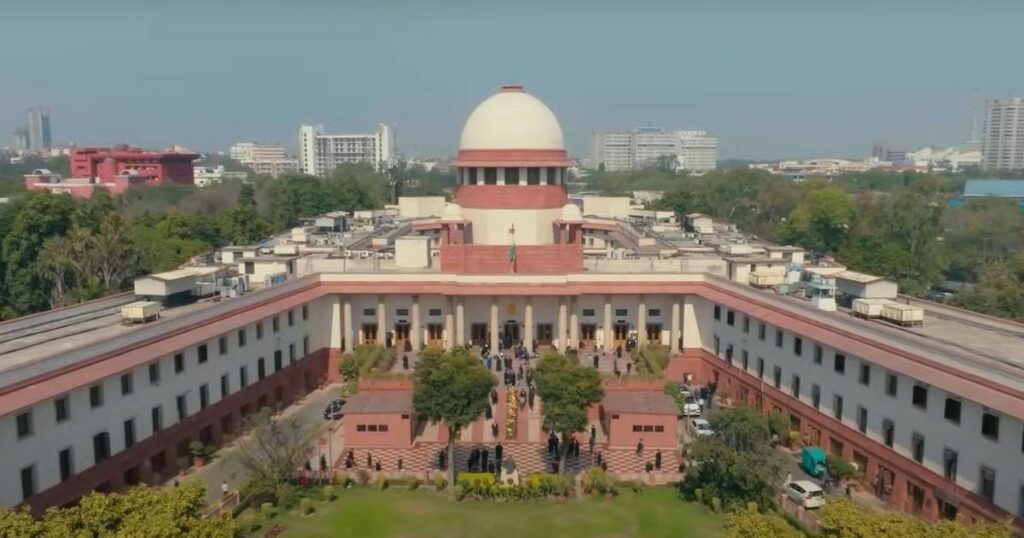
In a landmark judgment, the Supreme Court of India, led by Chief Justice B. R. Gavai and Justice K. Vinod Chandran, has struck down several crucial provisions of the Tribunals Reforms Act, 2021. The court held that the government’s attempt to reintroduce earlier invalidated clauses, with only minor changes, amounted to a “legislative override” of binding judicial precedents, a move incompatible with the principle of constitutional supremacy.
What the Court Ruled
The Court declared that Sections 3–7 and 33 of the 2021 Act, which deal with the appointment, tenure, and service conditions for tribunal members, are unconstitutional.
In particular, it struck down Section 5, which had limited tribunal chairpersons and members to a four-year tenure, reintroducing the earlier five-year term that the Court had prescribed.
The judgment also invalidated a minimum age requirement (50 years) for appointments to tribunal posts, observing that it arbitrarily excluded younger, capable lawyers and experts.
The bench ruled that these provisions violated separation of powers and judicial independence, core constitutional values.
The court expressed dismay that the central government had “merely reproduced … in slightly altered form, the very provisions earlier struck down.”
Parliament Cannot Bypass the Court
Perhaps most significantly, the Court rejected the idea that Parliament can simply “tweak” its way around judicial decisions. CJI Gavai emphasized that once the Supreme Court interprets the Constitution and declares a provision invalid, that ruling becomes authoritative and binding. According to the Court, Parliament’s power to legislate is not absolute it must operate within the limits set by the Constitution, including respect for the Court’s prior rulings.
The bench said that a valid legislative response must cure the constitutional defect identified in judicial rulings, not merely restate the problematic provision under a different label.
What Happens Now
The Supreme Court has directed the Centre to set up a National Tribunals Commission within four months. This body is meant to safeguard the independence, transparency, and uniform functioning of all tribunals.
Until a fresh statutory framework is enacted, the Court’s earlier judgments which had prescribed the five-year tenure rule, age norms, and selection processes will continue to apply.
For existing tribunal members whose appointments happened before or around the 2021 Act, the Court has clarified that their service conditions will follow the earlier judicially mandated regime, not the curtailed terms introduced by the now-struck-down provisions.
Why This Matters
Tribunals play a critical role in India’s justice system they are quasi-judicial bodies that handle specialized disputes (tax, commercial, regulatory, environment, etc.) and often ease the burden on traditional courts. By invalidating the 2021 Act, the Supreme Court has reasserted that the executive and legislature cannot undermine the structural independence of tribunals, a principle the Court considers fundamental to maintaining fairness, impartiality, and the correct functioning of justice.
Court’s Strong Message to the Government
CJI Gavai’s bench expressed “displeasure” at the government’s repeated failure to follow the Court’s prior directions, terming it a serious affront to judicial authority. The decision sends a clear warning: Parliament may legislate, but it must do so in a manner that respects constitutional boundaries and judicial pronouncements, rather than trying to sidestep them.