In a powerful example of service beyond the battlefield, the Indian Army’s Northern Command has brought life-changing relief to hundreds of residents in Jammu & Kashmir through a large-scale eye-care initiative titled Operation Drishti. The four-day special surgical camp, held from November 18 to 22, delivered advanced ophthalmic treatment to communities spread across some of the toughest Himalayan terrains.
More than 2,000 people underwent detailed screening during the camp, and over 400 complex surgeries were performed ranging from cataract removal and glaucoma treatment to intricate retinal procedures. The initiative was spearheaded by the Command Hospital, Northern Command, Udhampur, in collaboration with a specialised team from the Army Hospital (Research & Referral), New Delhi.
A Lifeline for Remote Communities
People travelled from regions such as Udhampur, Doda, Rajouri, Poonch, Kishtwar and Ramban to receive treatment, many of them having struggled for years without access to specialised eye care. Beneficiaries included serving soldiers, veterans, Veer Naris (war widows), and civilians living in border villages still affected by the shadow of conflict.
Among the most heartwarming moments was the successful surgery of 96-year-old Rajkumari Devi, who regained her eyesight after years of deteriorating vision. Doctors described her recovery as one of the most emotional highlights of the mission.
The camp also became a source of empowerment for many who had long been suffering in silence. Surinder Singh, a 72-year-old resident of Poonch and survivor of intense shelling during Operation Sindoor, emerged from surgery with renewed confidence. Instead of turning inward, he became an active motivator in his community, encouraging others affected by trauma and disability to seek medical help.
A similar spirit was seen in Abdullah Shafeeq, a retired soldier from Mendhar, who helped connect distressed civilians with the Army’s medical teams, ensuring that those hesitant or unable to travel found a guiding hand.
Leadership Behind the Mission
Operation Drishti took shape after Defence Minister Rajnath Singh endorsed a proposal forwarded by Jammu & Kashmir Lieutenant Governor Manoj Sinha. Following this, Chief of Army Staff General Upendra Dwivedi tasked the Armed Forces Medical Services with designing and executing a large-scale medical outreach programme directly in the operational zone.
The surgical team was led by Brigadier S.K. Mishra, Head of Ophthalmology at Army Hospital (R&R), whose distinguished career includes treating two Presidents of India.
At the closing ceremony, both Rajnath Singh and Gen Upendra Dwivedi addressed the gathering virtually, praising the Northern Command and its medical teams for their humanitarian contribution. Lieutenant Governor Manoj Sinha attended the event in person alongside Lt Gen Pratik Sharma, GOC-in-C Northern Command.
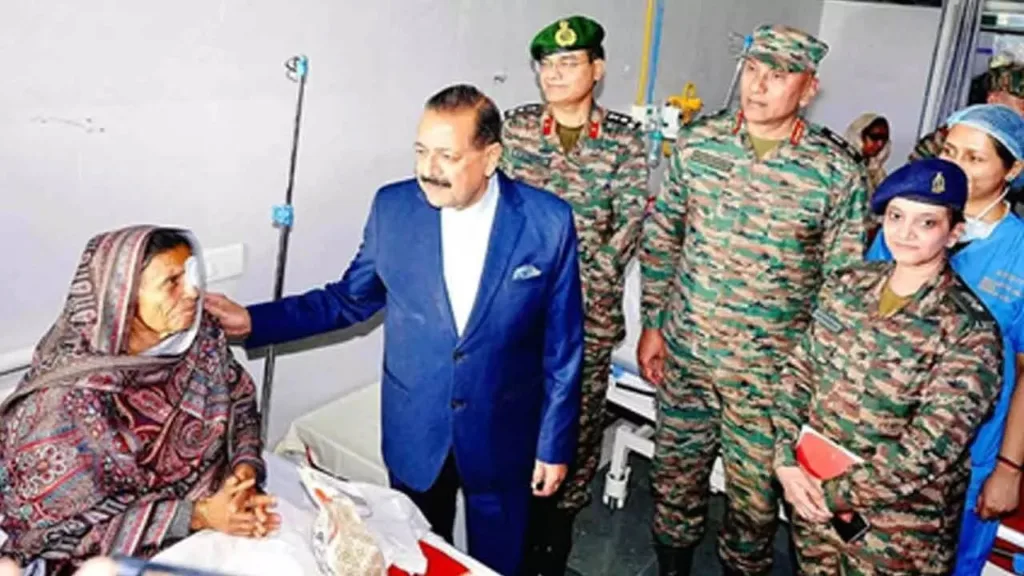
Union Minister Dr Jitendra Singh also visited the camp on November 20, interacting with patients and reviewing ongoing eye-care initiatives at the hospital. He lauded the Army for demonstrating that its commitment to the nation extends far beyond conflict zones.
Restoring Vision, Rebuilding Lives
For the people of Jammu & Kashmir, Operation Drishti has been more than a medical exercise it has been an assurance of compassion, dignity and renewed hope. By bringing advanced healthcare to regions that need it the most, the Indian Army has reaffirmed its role not just as a defender of national borders, but as a steadfast partner in healing and humanitarian service.
The light restored in hundreds of eyes across the Union Territory stands as a testament to what coordinated leadership, military precision and human empathy can achieve together.