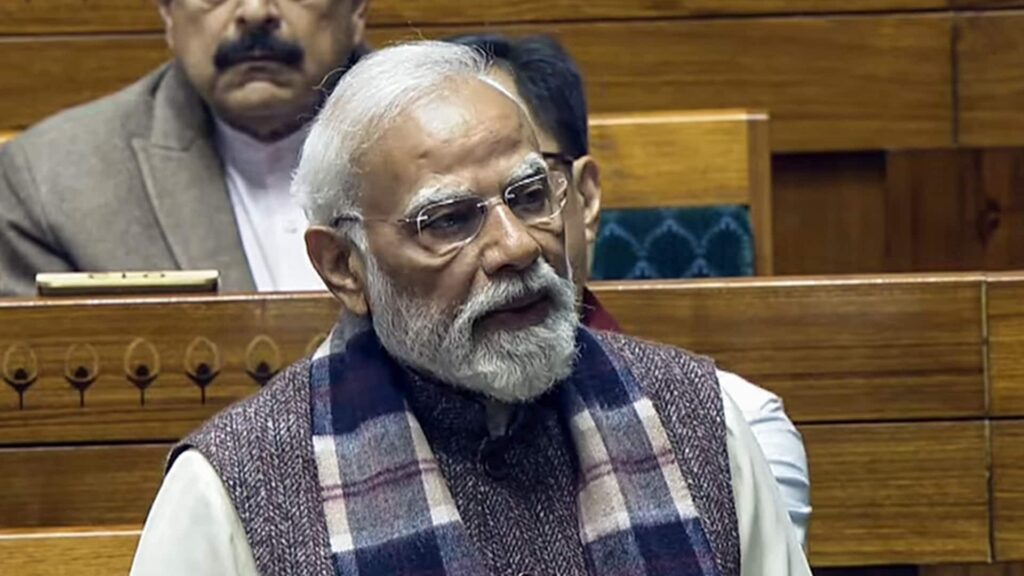
Today in the 2025 Winter Session of Parliament, Prime Minister Narendra Modi addressed a special debate in the Lower House to mark 150 years of the national song “Vande Mataram.”
Modi described “Vande Mataram” not as merely a hymn or poem, but as a “mantra” and a “sacred war-cry” that energized the Indian freedom struggle.
He said that when the British attempted to divide Bengal in 1905 and introduced “God Save the Queen” in Indian households, the song stood like a rock uniting the people, inspiring resistance and resilience.
According to him, at the centenary of “Vande Mataram,” the nation was trapped under the Emergency, a time he referred to as a dark chapter when the Constitution was “throttled.”
What He Emphasized: Legacy, Inspiration & National Unity
Modi urged that the 150-year milestone of “Vande Mataram” should not be just a moment of remembrance, but a chance to revive its spirit for a renewed, self-reliant India. He said the song’s cultural and spiritual energy rooted in thousands of years gave strength, unity and direction to the freedom movement.
He asked MPs across party lines to acknowledge the debt owed to “Vande Mataram,” and to use its spirit to drive the nation towards achieving the vision of a prosperous, developed India by 2047.
Political Undercurrent: Critique of the Past, Charges Against the Opposition
Modi didn’t restrict himself to praising the song, he also leveled harsh criticism at the political past of Indian National Congress (INC). He alleged that during India’s partition and in early years, the Congress had bowed to what he called “appeasement politics,” compromising the sanctity of “Vande Mataram” under pressure from the All‑India Muslim League.
He accused Congress of betraying the legacy of the national song, suppressing its full form including allegedly “omitted lines” and failing past generations who fought under its banner.
He invoked the period of Emergency (1975-77) as another moment when “Vande Mataram’s” legacy was dishonored: those who lived and died for patriotism were imprisoned, he said.
Reactions, Debate, and Opposition Pushback
Not everyone welcomed the tone of the speech. Opposition voices particularly from Indian National Congress accused Modi of giving a “political colour” to what should have been a non-partisan commemoration.
One leader criticized the address as an attempt to “rewrite history,” arguing that “Vande Mataram” had long been respected by Congress, and accusing the government of using the debate for political gain.
The exchange underscored the volatile mix of national symbols, history and politics with the debate quickly transforming from cultural-historical reflection to political confrontation.
Why This Matters: Symbolism, Identity and Future Direction
The 150-year anniversary of “Vande Mataram” is being used as a platform to revisit and re-evaluate its place in India’s history, identity and collective memory.
With the spotlight back on this national song, its roots in cultural unity and freedom struggle are being highlighted but so is the controversy over how political powers have treated it.
The debate reflects broader questions about how national symbols are used, remembered, and sometimes politicized, a conversation that will likely continue not just in Parliament, but across public discourse.