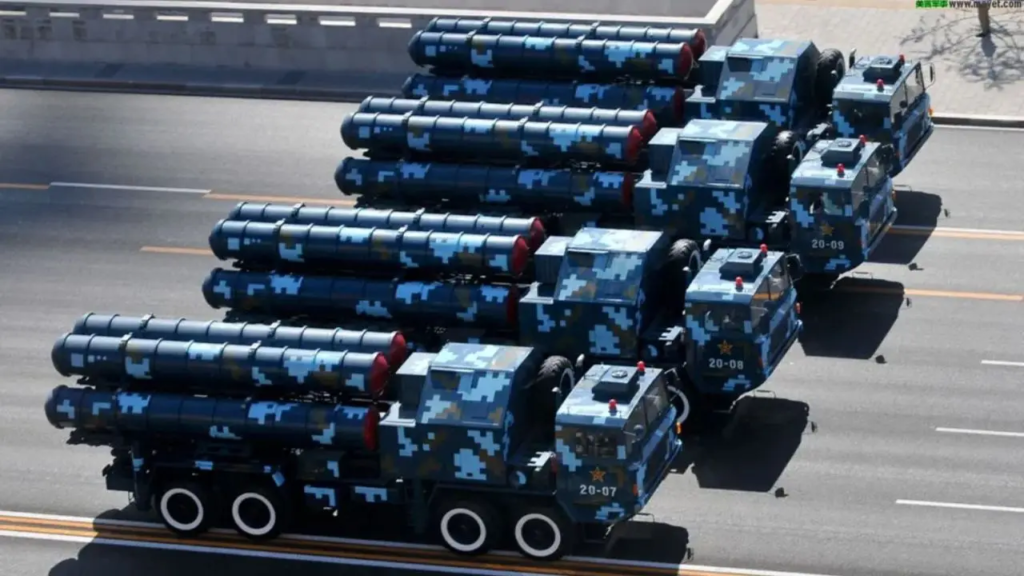
China’s HQ-9B long-range surface-to-air missile (SAM) system long touted by Beijing as a cornerstone of its advanced air-defence arsenal and a flagship export item is facing intense international scrutiny after a string of reported shortcomings in real-world combat scenarios. Its apparent inability to effectively counter high-end aerial threats in Iran and Pakistan has raised serious questions about its battlefield credibility and could dent China’s broader ambitions in the global arms market.
Second High-Profile Setback in Less Than a Year
The latest controversy stems from US-Israeli airstrikes on Iran over the past week, which devastated strategic targets across more than 20 Iranian provinces. Despite Tehran’s deployment of layered air-defence systems including Russian S-300 batteries, Iranian-built Bavar-373 radars, and Chinese-made HQ-9B units the aerial campaign reportedly overwhelmed the integrated shield. Initial assessments suggest the HQ-9B failed to intercept stealth aircraft and precision munitions or significantly slow the strikes’ impact.
Analysts and defence experts have pointed to gaps in the Iranian air-defence network, including possible shortcomings in sensor integration, command-and-control linkages, and electronic warfare resilience. These vulnerabilities may have limited the HQ-9B’s effectiveness even if the system performed to its technical specifications.
Echoes of Operation Sindoor
This is not the first time the HQ-9B’s performance has been called into question. During India’s Operation Sindoor in May 2025 a coord niinated series of air and missile strikes against Pakistani military targets Pakistan’s Chinese-supplied air-defence grid reportedly failed to intercept incoming threats effectively, allowing Indian forces to strike multiple bases with precision munitions. The episode triggered considerable debate among military analysts about whether the system lives up to its advertised capabilities.
A leading US security analyst at the time described the Pakistani deployment of the HQ-9B as a “Frankenstein’s Monster” a mismatched assembly of technologies struggling to handle advanced threats.
Technical Claims vs Battlefield Reality
Developed by the China Aerospace Science and Industry Corporation (CASIC), the HQ-9B has been marketed as China’s answer to Western-style air-defence systems such as the US Patriot and Russian S-300/S-400 families, boasting a reported engagement range of around 260 kilometres and the ability to intercept multiple targets simultaneously.
However, the recent incidents highlight the growing gap between the system’s theoretical specifications and its operational performance under modern, saturated attack conditions involving stealth platforms, stand-off weapons, and sophisticated electronic warfare. Critics argue that such advanced threats exploit inherent blind spots in radar coverage, slow software response times, and the lack of seamless integration across sensor networks issues that have repeatedly surfaced in recent conflict zones.
Implications for China’s Defence Exports
China has aggressively pursued arms export markets across Asia, the Middle East, Africa, and Latin America, positioning its systems as cost-competitive alternatives to Western and Russian hardware. But repeated battlefield setbacks from Pakistan to Venezuela and now Iran risk undermining that narrative
Defense analysts caution that potential buyers are now likely to scrutinize Chinese defence hardware more closely, demanding robust proof of performance and stronger after-sales support before committing to major deals. With rivals such as the US and European producers emphasizing combat-tested credibility, Beijing may need to reassess its export strategy to maintain competitiveness.
What Comes Next?
China’s official response to these developments has been muted. Beijing has denied supplying HQ-9B systems to Iran despite multiple independent reports suggesting otherwise and continues to defend the system’s design and capabilities.
For its part, Iran has yet to release a comprehensive assessment of how each component of its air-defence network fared under attack. Military observers believe the events will prompt urgent efforts to shore up weaknesses, either through upgrades or by acquiring additional layers of defence technology.
As geopolitical tensions flare and advanced aerial threats proliferate globally, the performance of long-range SAM systems like the HQ-9B will remain at the centre of defence debates underscoring the high stakes of modern air warfare and the evolving calculus of military procurement.