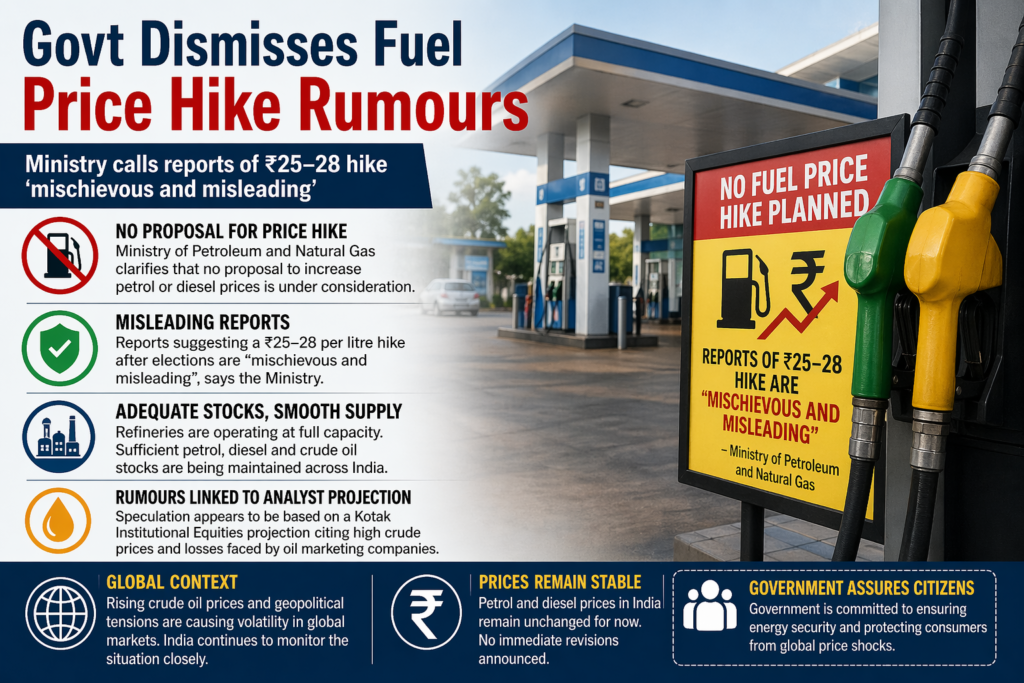
The Ministry of Petroleum and Natural Gas has firmly denied reports suggesting a sharp increase of ₹25–28 per litre in petrol and diesel prices, calling such claims “mischievous and misleading” and clarifying that no such proposal is under consideration.
No Proposal for Price Hike
In an official statement issued on April 23, the government rejected speculation that fuel prices would be raised significantly after ongoing elections. The ministry stated that such reports are baseless and intended to create unnecessary panic among citizens.
The clarification comes amid widespread circulation of reports claiming that petrol and diesel prices could rise by up to ₹28 per litre. These claims were linked to a projection by Kotak Institutional Equities, which had highlighted the financial strain on oil marketing companies due to rising global crude oil prices.
Origin of the Speculation
According to market analysts, the projection was based on elevated crude oil prices hovering around $100–120 per barrel and the widening gap between international oil costs and domestic retail prices.
Kotak Institutional Equities had suggested that such a hike might be required to offset mounting losses faced by refiners, estimated at billions of rupees per month. However, the government clarified that this was merely an external assessment and not under active consideration.
Adequate Fuel Stocks, Stable Supply
The ministry also reassured the public that India’s energy supply remains stable. Refineries are operating at full capacity, and sufficient stocks of petrol, diesel, and crude oil are being maintained across the country.
India, one of the world’s largest crude oil importers, has taken several steps in recent months to shield consumers from global volatility. These include tax cuts and strategic sourcing of crude from multiple countries.
Global Context: Rising Crude, Geopolitical Tensions
The speculation around fuel prices comes at a time when global oil markets are under pressure due to geopolitical tensions, particularly in West Asia. Disruptions in key supply routes like the Strait of Hormuz have contributed to price volatility and concerns over supply constraints.
Ratings agency Moody’s has also warned that prolonged energy disruptions could widen India’s trade deficit and increase inflationary pressures, highlighting the broader economic risks tied to rising crude prices.
Prices Remain Unchanged, for Now
Despite global volatility, retail fuel prices in India have remained largely stable in recent weeks, with no immediate revisions announced.
While global crude oil prices continue to fluctuate and analysts warn of potential pressure on fuel pricing, the Indian government has made it clear that there is currently no plan to increase petrol or diesel prices. With adequate fuel stocks and stable refinery operations, authorities have sought to reassure citizens and curb misinformation circulating on the issue.