Against the backdrop of escalating geopolitical tensions in the Middle East, the Indian government has activated a suite of enhanced maritime security and monitoring measures to safeguard Indian-flagged vessels and seafarers operating in the Persian Gulf, Strait of Hormuz, Gulf of Oman and adjacent waters.
Union Minister for Ports, Shipping and Waterways Sarbananda Sonowal chaired a high-level review meeting to assess the evolving security environment and its potential impact on India’s maritime assets and personnel. Officials say the situation has grown increasingly volatile due to reported missile and drone activity and other risks in these strategically vital sea lanes.
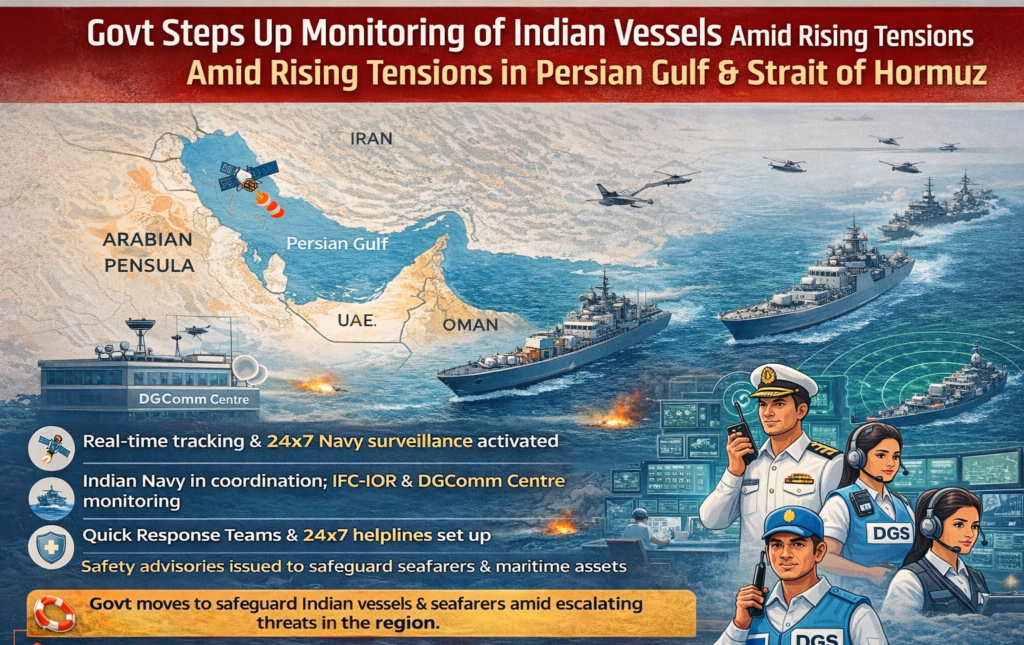
Real-Time Tracking & 24×7 Surveillance Activated
The Directorate General of Shipping (DGS) has initiated real-time tracking of Indian-flagged vessels, requiring higher reporting frequencies and establishing round-the-clock monitoring through the Maritime Mobile Data Acquisition and Communication (MMDAC) DGComm Centre. Mandatory reporting protocols have been introduced for ship masters, vessel owners and managers.
Close coordination has been ensured with key national agencies including the Indian Navy, Ministry of External Affairs (MEA), the Information Fusion Centre–Indian Ocean Region (IFC-IOR), the Maritime Rescue Coordination Centre (MRCC) and Indian diplomatic missions abroad.
Quick Response Teams & Helplines Set Up
To ensure swift action in case of emergencies, a dedicated Quick Response Team (QRT) has been formed. The team will coordinate between authorities, provide timely assistance and streamline communications with seafarers and their families. Helpline numbers have also been activated and disseminated through official channels to facilitate immediate support.
Shipping firms and crew-recruitment agencies have been advised to exercise caution when deploying personnel, maintain regular communication with seafarers at sea, and carry out voyage-specific risk assessments.
Safety Advisory Amid Heightened Risks
While there have been no confirmed detentions or boardings of Indian-flagged vessels, incidents in the broader region have resulted in casualties involving Indian seafarers aboard foreign vessels, underscoring the urgency of precautionary steps.
The Strait of Hormuz, a critical chokepoint for global energy transport remains sensitive to disruptions. India’s proactive steps aim to protect vital maritime trade routes and the welfare of its sailors, many of whom serve on international shipping lines in these waters.
Government Readiness and Outlook
In reaffirming the government’s commitment, officials stress that existing mechanisms can be scaled up further depending on how the situation unfolds. Strategic coordination with allied nations and international maritime agencies continues as part of broader efforts to maintain safe navigation and protect Indian interests at sea.