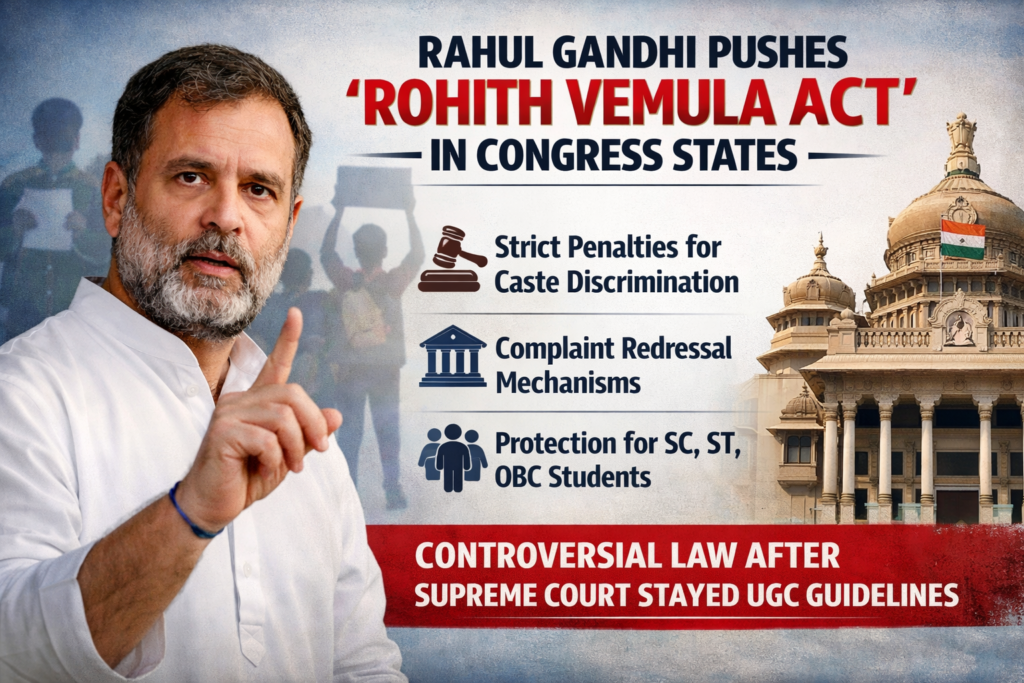
Congress leader Rahul Gandhi has urged all Congress-ruled states to introduce legislation known as the Rohith Vemula Act, aimed at tackling caste-based discrimination in higher educational institutions. The move comes as the Congress government in Karnataka prepares to bring the law, potentially setting a precedent for other states such as Telangana and Himachal Pradesh.
Background: The Rohith Vemula Case
The proposed law is named after Rohith Vemula, a PhD scholar at the University of Hyderabad who died by suicide in 2016. His death sparked nationwide debate over alleged caste-based discrimination on university campuses and prompted calls for stronger institutional safeguards for students from marginalized communities.
Karnataka Leads with Proposed Legislation
The Congress government led by Chief Minister Siddaramaiah has announced plans to enact the Rohith Vemula (Prevention of Exclusion or Injustice) Bill, which seeks to curb caste discrimination across government, private and deemed universities in the state.
Key provisions reportedly include:
Criminal penalties such as fines and imprisonment for caste-based discrimination on campuses.
Institutional accountability mechanisms, including complaint redressal systems.
Protection measures for students belonging to Scheduled Castes (SC), Scheduled Tribes (ST), Other Backward Classes (OBC), and minority communities.
In some drafts discussed earlier, the law proposed penalties of up to three years in jail and fines up to ₹1 lakh for those found guilty of discrimination.
Push to Expand Across Congress-Ruled States
Rahul Gandhi has previously written to the chief ministers of Congress-ruled states including Telangana and Himachal Pradesh urging them to adopt similar legislation. According to reports, he described the proposed Act as a step toward ensuring justice and dignity for students from marginalized communities.
If enacted beyond Karnataka, the legislation could become a model law across Congress-governed states, potentially reshaping anti-discrimination frameworks in higher education.
Legal Context and Controversy
The debate around the Rohith Vemula Act has intensified after the Supreme Court of India stayed the implementation of the UGC (Promotion of Equity in Higher Education Institutions) Regulations, 2026, citing concerns that some provisions were vague and could be misused. The court directed that the earlier 2012 rules continue for now.
Supporters argue that stronger legislation is needed to address structural discrimination faced by marginalized students, while critics warn that broadly defined provisions could lead to legal disputes and misuse in academic settings.
What Comes Next
The Karnataka government is expected to table the bill in the state legislature soon. If passed, it would be the first dedicated state law aimed specifically at combating caste-based discrimination in higher education, potentially paving the way for similar measures in other Congress-ruled states.