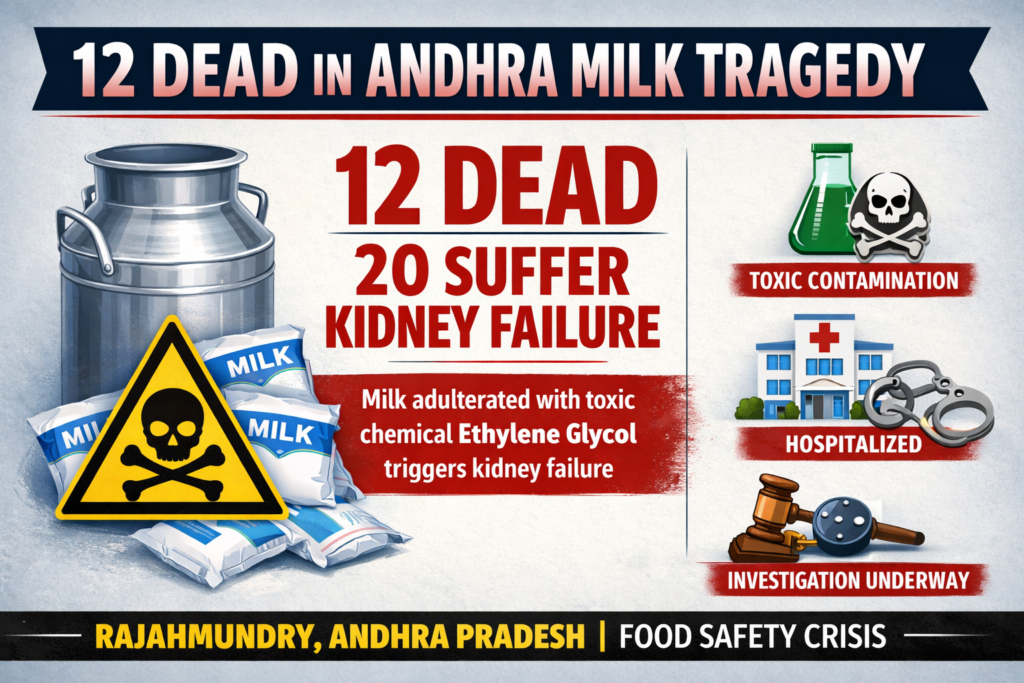
20 people suffer acute renal failure; investigation points to toxic coolant leaking into milk storage system.
Amaravati / Rajahmundry:
A shocking case of food adulteration has emerged in Andhra Pradesh’s East Godavari district, where the death toll linked to contaminated milk has risen to 12, triggering serious concerns about food safety and regulatory oversight in the country.
The latest victim, a 73-year-old woman from Lalacheruvu in Rajahmundry, died while undergoing treatment for acute renal failure after consuming milk contaminated with ethylene glycol, a toxic industrial chemical.
According to district authorities, around 20 people developed acute kidney failure after consuming the adulterated milk. Several victims reported symptoms such as vomiting, urinary obstruction and severe kidney complications, with nine patients including three infants still battling for their lives in hospitals.
How the Contamination Happened
Preliminary investigations indicate that the contaminated milk was supplied by a local dairy unit, Varalakshmi Milk Centre, operated by a vendor identified as Addala Ganeswara Rao. Authorities found that the milk was collected from multiple farmers and stored in containers inside a freezer before being distributed to households in Rajahmundry.
Investigators suspect that ethylene glycol leaked into the milk from a faulty refrigeration system used for storage. Ethylene glycol is a chemical commonly used in automotive antifreeze and industrial cooling systems and is highly toxic if ingested.
Forensic analysis confirmed that the victims suffered acute renal failure caused by ingestion of the contaminated milk, leading to multiple deaths over the past few weeks.
Investigation Underway
Following the incident, police registered a case under the Bharatiya Nagarik Suraksha Sanhita (BNSS) and seized milk samples, storage containers and equipment from the dairy unit for forensic examination. The accused vendor has reportedly been taken into custody as investigators attempt to determine whether the contamination was accidental or due to negligence.
Authorities have also launched house-to-house surveys and medical monitoring in affected neighbourhoods to identify additional cases.
Concerns Over Food Safety
The tragedy has once again highlighted the persistent issue of food adulteration in India. The Food Safety and Standards Authority of India (FSSAI), the country’s apex food safety regulator, has sought detailed reports on the incident and is monitoring the investigation.
Public health experts warn that chemicals such as ethylene glycol can cause severe kidney damage within days of ingestion, making early detection and strict monitoring of food supply chains critical.
The incident has triggered outrage among citizens and renewed calls for stricter enforcement and harsher penalties against those responsible for adulterating food products, especially essential items such as milk that are widely consumed by children and the elderly.