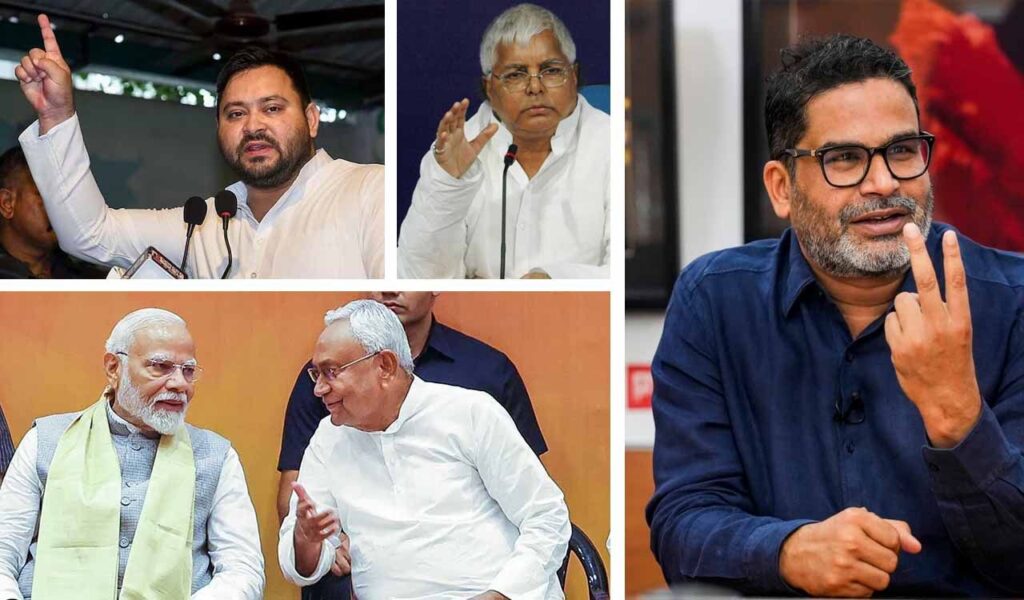
The 2025 Bihar Assembly election delivered one of the sharpest, most fragmented verdicts the state has seen in years. While the contest was largely viewed as a direct clash between the NDA and the Mahagathbandhan (MGB), a third player Prashant Kishor’s Jan Suraaj Party (JSP) ended up adding an unexpected layer of complexity.
The party did not win a single seat. Yet, its presence across the electoral map left measurable footprints that reshaped margins, voter behaviour, and overall competitiveness.
A Wide Footprint but Thin Ground Support
Jan Suraaj entered the polls with a high-voltage campaign centred on governance reforms, decentralised leadership, and citizen-first politics. The party contested 238 constituencies nearly the entire state but its vote share remained scattered and inconsistent.
Key performance metrics:
Overall vote share: 3.5%
Seats contested: 238
Seats won: 0
Ranked second: 1 seat
Ranked third: 115 seats
Polled fewer votes than NOTA in ~60 seats
Independents collectively outperformed JSP with nearly 5% vote share
The party showed pockets of moderate traction, with candidates polling between 10,000–15,000 votes in 18 seats, and crossing 35,000 votes in three constituencies, including one where the NDA nominee was disqualified. But nowhere did Jan Suraaj become a decisive challenger.
Where JSP Outpolled the Winning Margin
One of the most debated questions is whether JSP “cut” votes from either major alliance. The data shows:
JSP’s vote count exceeded the final victory margin in 36 seats.
In 10 of these, the same party won in both 2020 and 2025, suggesting JSP did not alter electoral outcomes.
The remaining 26 seats did see a change in winner, but attributing those flips solely to Jan Suraaj oversimplifies the picture.
These constituencies were heavily influenced by:
stronger third-party players (LJP, RLSP, AIMIM)
local anti-incumbency
shifting caste dynamics
alliance realignments since 2020
candidate switching and last-minute withdrawals
For instance, in Sherghati, LJP’s impact in 2020 had already destabilised the NDA vote base. Its return to the NDA fold in 2025 reversed that trend independent of Jan Suraaj’s performance.
JSP as a Fragmenting Force, Not a Decisive One
In most of these 26 “vote-slice” seats, JSP contributed to narrowing margins and increasing unpredictability. But it acted as one of many fragmenting forces, rather than the catalyst that changed outcomes. Bihar’s political field in 2025 was crowded, volatile, and deeply influenced by hyper-local equations.
How PK’s Campaign May Have Helped the BJP
Interestingly, some political watchers argue that Prashant Kishor’s state-wide padyatra and sharp criticism of governance inadvertently benefited the BJP in several regions.
This was less about the votes JSP received, and more about the electoral psychology the campaign created:
1. Risk-averse voters felt Jan Suraaj could not win, and avoided “wasting” their ballot in a close race.
2. Kishor attacked both alliances, but fears of a possible RJD comeback pushed many anti-MGB voters to consolidate behind the BJP.
3. PK’s focus on unemployment, education and migration heightened voter sensitivity but the “fear of instability” narrative worked in BJP’s favour.
4. In several seats, undecided voters interpreted PK’s critique of JDU as a signal to back the BJP as the stronger counterweight to MGB.
The result was an environment where Jan Suraaj did not gain significantly, but its messaging sharpened choices for other parties.
Conclusion
Jan Suraaj entered the Bihar election with ambition but ended up functioning more as a disruptive presence than a competitive force.
It did not win seats,
did not emerge as a major challenger,
but influenced margins,
fragmented votes,
and indirectly shaped voter consolidation patterns in a tight race.
In 36 seats, its vote share exceeded the winning margin but only in 26 did the winner change, and even those were driven by a complex mix of local issues and multi-party dynamics.
The 2025 Bihar election ultimately turned on fine margins and fractured mandates. Jan Suraaj may not have changed who governed the state, but it undeniably changed how the battle was fought adding unpredictability and highlighting how even small parties can influence the rhythm of a major electoral contest.