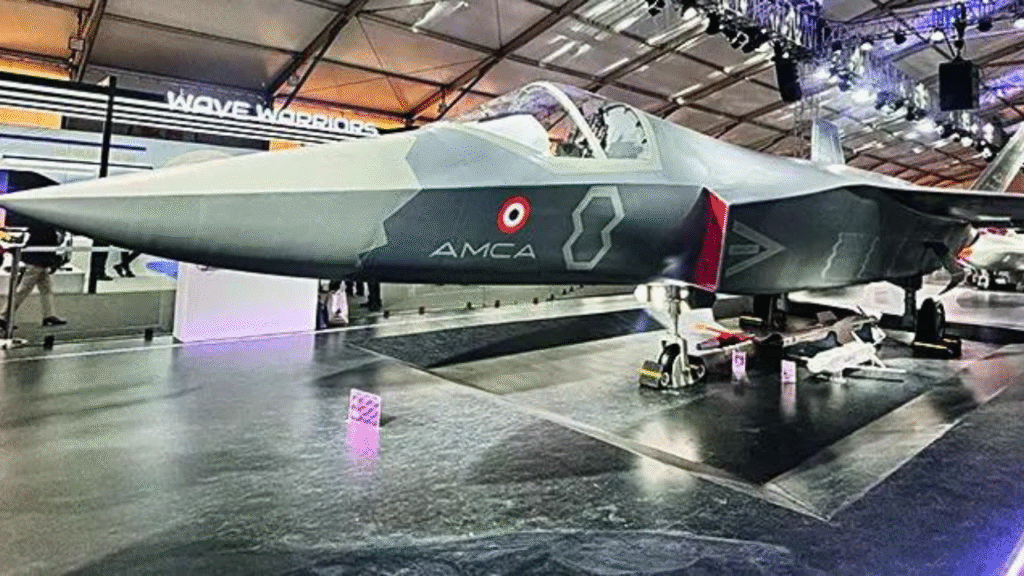
In a major milestone for India’s defence aerospace ambitions, the Defence Research and Development Organisation (DRDO) has shortlisted three private sector contenders to design and develop prototypes of the country’s Advanced Medium Combat Aircraft (AMCA) India’s indigenous fifth-generation stealth fighter jet.
The selected firms are:
Tata Advanced Systems Ltd, bidding independently
A consortium led by Larsen & Toubro (L&T) and Bharat Electronics Ltd (BEL)
A consortium led by Bharat Forge, joined by BEML Ltd and Data Patterns
These industry contenders emerged from an initial pool of seven bidders that included other private players such as Adani Defence and the state-run Hindustan Aeronautics Limited (HAL) which notably failed to clear the financial evaluation stage and was excluded from the prototype competition, marking a historic shift away from traditional public sector dominance in fighter development.
A Leap Toward Indigenous Stealth Capabilities
The AMCA programme represents India’s most ambitious attempt at developing a homegrown, fifth-generation multi-role combat aircraft, a platform designed for air superiority, precision strike, electronic warfare and network-centric operations with advanced stealth characteristics. The twin-engine jet is expected to feature internal weapons bays, advanced sensor fusion and super-cruise capability (sustained supersonic flight without afterburners).
Under the current plan, the selected company or consortium will partner with DRDO’s Aeronautical Development Agency (ADA) to build five prototypes and a structural test specimen, with government funding support facilitating early-stage development work
Officials indicate that the first prototypes are targeted for completion in the late 2020s, with initial maiden flights possibly by 2029, followed by extensive testing and certification ahead of a planned induction into the Indian Air Force (IAF) by around 2035.
Strategic Impact and Global Context
If the programme stays on track, India will join an exclusive club of nations operating fifth-generation fighters, alongside the United States with its F-22 Raptor and F-35 Lightning II, China with the Chengdu J-20, and Russia with the Sukhoi Su-57.
The strategic imperative for AMCA grows amid regional security challenges. China has deployed its J-20 stealth fighters and is reportedly advancing additional next-generation platforms, while Pakistan is also pursuing advanced fighters, potentially including J-35 variants.
The shift to involve private industry at the forefront of such a complex defence project particularly by sidelining HAL in this stage reflects a deliberate policy push by the Ministry of Defence to build a robust Atmanirbhar Bharat aerospace ecosystem and harness the engineering capacities of private Indian firms.
What Comes Next
Over the coming months, the shortlisted contenders are expected to submit detailed technical and commercial proposals. A final selection is anticipated by mid-2026 after rigorous evaluations. Successful bidders will then commence prototype development under government oversight.
Beyond AMCA, the Defence Ministry is also progressing with other initiatives to modernise the IAF’s fleet including plans for additional Rafale acquisitions and co-development of advanced engines for future aircraft underscoring a broad, long-term strategy to enhance India’s national defence capabilities