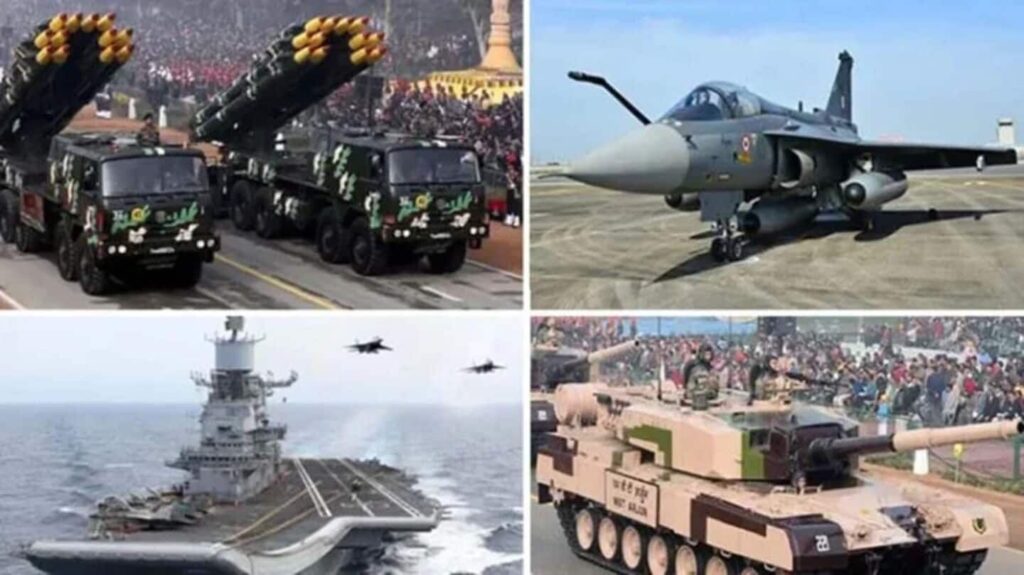
In a major boost to India’s Make in India and defence self-reliance efforts, the country is on the verge of producing a new generation of advanced weapons at home including the famed HAMMER smart bomb and KATANA precision artillery munitions while also setting up facilities to build fighter jet components and engines.
BEL–Safran JV to Make HAMMER in India
Bharat Electronics Limited (BEL) and France’s Safran Electronics & Defence (SED) have formalized a 50:50 joint venture cooperation agreement (JVCA) to manufacture the HAMMER (Highly Agile Modular Munition – Extended Range) smart air-to-ground weapon in India.
The HAMMER system, known for its modular design and combat-proven precision, was used by India during “Operation Sindoor” to strike terrorist targets. According to the deal, this joint venture will handle manufacturing, supply, customization, and maintenance of the munitions for the Indian Air Force and Navy.
Over time, the plan is to localize up to 60% of the components. Key sub-assemblies, electronics, and mechanical parts are slated for production within India, while BEL will lead final assembly, quality testing, and validation.
Strategic Implications for Air Power
The HAMMER is not just powerful, but also flexible: it can be mounted on both lighter fighters like Tejas and heavier platforms like the Rafale. Its design gives it strong resistance to jamming, even at low altitudes and in adverse weather making it ideal for precision strikes.
By manufacturing HAMMER in India, the country will reduce its import dependency and achieve cost advantages. The JV signals a growing maturity of India’s defence industrial base, aligning with the government’s vision for self-reliance (Atmanirbhar Bharat).
Rafale Fuselage and Jet Engines to Be Built Domestically
But the HAMMER deal is just one part of a broader push. India is also establishing a production facility in Hyderabad to build the fuselage (the main body structure) of the Rafale fighter jet, according to defense sources. The effort underscores India’s ambition to become a global hub for advanced aerospace manufacturing.
On the engine front, India, through an agreement between Safran and the Defence Research and Development Organisation (DRDO), is developing a new 120 kN-class jet engine. This future engine is expected to power next-generation platforms, potentially including a fifth-generation stealth aircraft. Technology transfer is a key part of the deal, enabling India to build critical aero-engine systems in the long run.
KATANA Precision Artillery Joins the Arsenal
In parallel, India has struck another deal to modernize its artillery. SMPP, an Indian defence firm, has signed a teaming agreement with European group KNDS to produce the KATANA® family of 155 mm precision-guided artillery munitions.
The KATANA range includes Ballistic Range (BR), Extended Range (ER), and High Precision (HP) variants, some equipped with laser seeker technology. These munitions use a hybrid guidance system combining multi-constellation GNSS (Global Navigation Satellite System) receivers with an Inertial Measurement Unit (IMU), giving them strong accuracy in challenging environments.
Future versions are expected to include a semi-active laser seeker for metric-level precision, and the munitions support fire-and-forget modes critical for modern, fast-paced battlefield operations.
Under this collaboration, SMPP and KNDS will offer KATANA munitions to the Indian Army under the Make in India framework, strengthening India’s indigenous artillery capabilities.
Why It Matters: A Game-Changer for Indian Defence
Taken together, these developments represent a significant shift in India’s defense production landscape:
1. Reduced Import Dependency: Producing HAMMER and KATANA domestically means India no longer has to rely purely on foreign suppliers for critical precision weapons.
2. Technology Transfer & Skill Build-Up: Through these partnerships, India gains not just production capacity but also access to advanced design, testing, and quality-assurance know-how.
3. Strategic Autonomy: By building jet fuselages, engines, and smart munitions in India, the country is strengthening its defense sovereignty.
4. Economic & Industrial Boost: Such high-technology manufacturing will create jobs, spur innovation, and potentially position India as an arms-export hub in the future.
Challenges Ahead
Despite the optimism, there are challenges. Scaling production to meet the planned 60% indigenization in the HAMMER JV will require infrastructure, quality control, and supply chain readiness. The development of the new jet engine will demand years of R&D and rigorous testing before it can power frontline aircraft. On the artillery side, adapting the KATANA munitions for Indian operational needs and producing them at scale will test the manufacturing ecosystem.
With these twin pushes for smart aerial weapons and precision artillery, India is not just buying cutting-edge military systems; it is becoming a maker of them. The Make in India program is being translated into real, high-tech defense capacity, strengthening India’s strategic posture and boosting its technological sovereignty