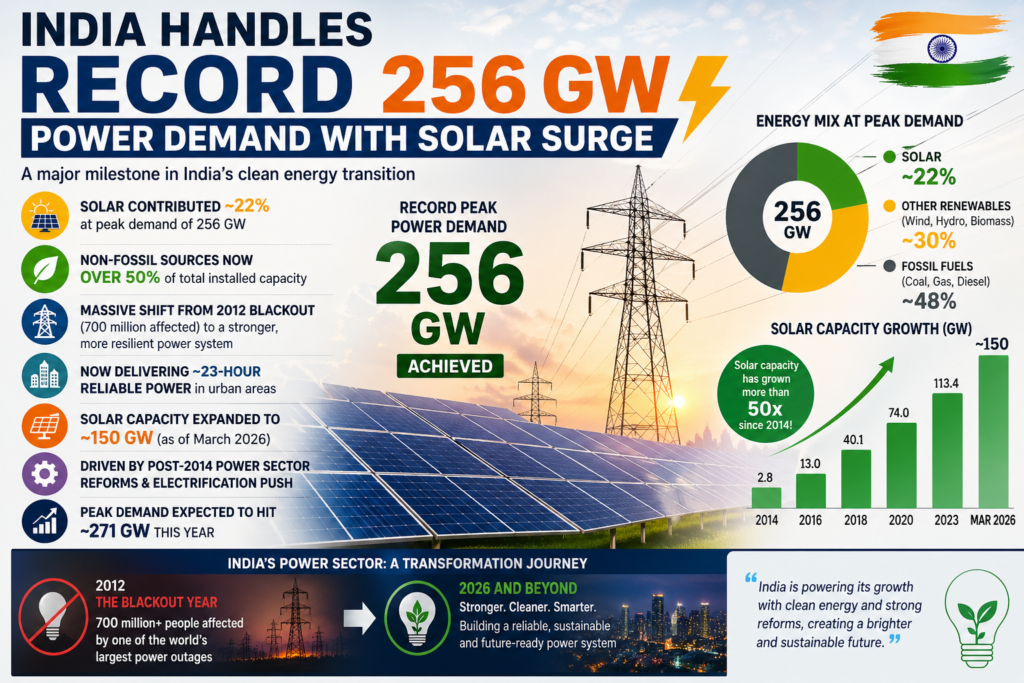
India has successfully met its highest-ever electricity demand of 256 gigawatts (GW), marking a major milestone in the country’s rapidly evolving power sector. The record peak, driven largely by intense summer heat, underscores both the rising energy needs of a growing economy and the increasing role of renewable energy especially solar in meeting that demand.
Solar Steps Into the Spotlight
A defining feature of this milestone is the significant contribution of solar power. During peak daytime demand, solar energy accounted for a substantial share of electricity supply, highlighting its transition from a supplementary source to a central pillar of India’s energy mix.
India’s solar capacity has surged to around 150 GW as of March 2026, a dramatic increase from just 2.8 GW in 2014. This expansion has been driven by large-scale solar parks, rooftop installations, and policy support under successive renewable energy missions.
Non-Fossil Capacity Crosses 50%
India’s installed power capacity now exceeds 520 GW, with over 52% coming from non-fossil fuel sources, including solar, wind, hydro, and nuclear energy. This marks a structural shift in the country’s energy landscape, reducing dependence on coal while advancing climate commitments.
At the same time, conventional sources such as coal and gas continue to play a balancing role, particularly during extreme demand spikes like heatwaves.
From Blackouts to Reliability
The achievement reflects a remarkable transformation from the 2012 nationwide blackout, which affected over 700 million people. Today, India delivers near round-the-clock electricity in most urban areas, with significant improvements in grid stability, transmission infrastructure, and rural electrification.
Government data shows that power shortages have dropped sharply from over 4% a decade ago to nearly negligible levels today, thanks to investments in generation capacity and distribution reforms.
Demand Set to Rise Further
India’s power demand is expected to continue its upward trajectory, with projections indicating a peak of around 271 GW in 2026. Rapid urbanisation, industrial growth, and increasing use of cooling appliances are key drivers behind this surge.
The Next Challenge: Storage and Flexibility
Experts note that the next phase of India’s energy transition will hinge on improving grid flexibility and scaling up energy storage solutions. As renewable energy grows, managing its intermittency will become critical to ensuring reliable supply.
A Defining Energy Transition
India’s ability to meet record demand while integrating a growing share of renewable energy signals a turning point. The country is not only expanding capacity but also reshaping its power system to align with sustainability goals.
With solar at the forefront and demand continuing to rise, India’s energy journey now enters a new phase one that balances economic growth, energy security, and clean power expansion.