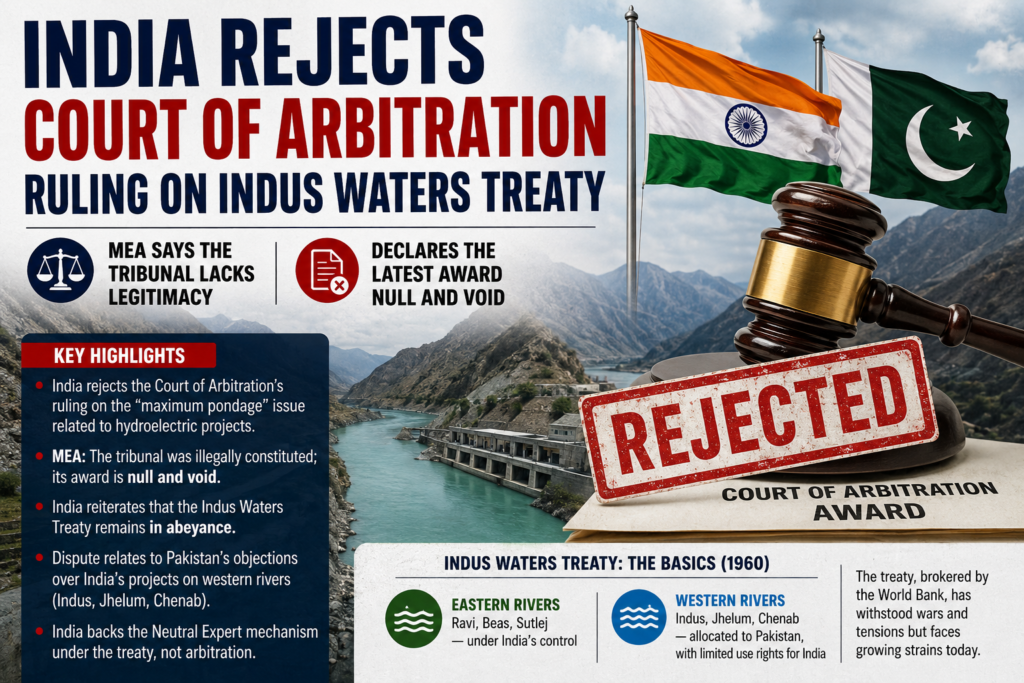
India has firmly rejected the latest ruling issued by the Court of Arbitration (CoA) under the 1960 Indus Waters Treaty (IWT), with the Ministry of External Affairs (MEA) declaring the tribunal “illegally constituted” and its award “null and void.”
The sharp response from New Delhi came after the arbitration body issued what it described as an award related to the “maximum pondage” issue concerning hydroelectric projects on the Indus river system. India reiterated that it has never recognised the legitimacy of the Court of Arbitration established at Pakistan’s request.
MEA spokesperson Randhir Jaiswal stated that India “categorically rejects” the latest award, just as it has rejected all previous pronouncements of the tribunal. According to the government, any proceedings or decisions emerging from the CoA carry no legal standing for India.
“India has never recognised the establishment of this so-called CoA. Any proceeding, award, or decision issued by it is null and void,” the MEA said.
India Maintains Treaty “In Abeyance”
The government also reaffirmed that its decision to keep the Indus Waters Treaty “in abeyance” remains in force. India had suspended participation in the treaty framework following heightened tensions with Pakistan and concerns over cross-border terrorism.
New Delhi maintains that while the treaty provides mechanisms for dispute resolution, Pakistan’s move to seek arbitration violated the agreed framework under the pact. India has instead backed the Neutral Expert mechanism for technical disputes linked to the Kishenganga and Ratle hydroelectric projects in Jammu and Kashmir.
The dispute centres around Pakistan’s objections to the design and operational features of India’s hydroelectric projects on western rivers allocated primarily to Pakistan under the treaty. The Court of Arbitration had earlier ruled that it was competent to hear Pakistan’s case, a decision India has consistently opposed.
Background of the Indus Waters Treaty
The Indus Waters Treaty was signed in 1960 between India and Pakistan with the World Bank acting as a facilitator. The agreement governs the sharing of waters from six rivers of the Indus basin system.
Under the treaty:
India has unrestricted use of the eastern rivers – Ravi, Beas and Sutlej.
Pakistan receives rights over the western rivers – Indus, Jhelum and Chenab with limited usage rights granted to India for hydropower and other non-consumptive purposes.
Despite multiple wars and prolonged political tensions, the treaty has historically survived as one of the world’s most enduring water-sharing agreements. However, disputes over hydroelectric projects and growing strategic tensions have increasingly strained the framework in recent years.
India’s latest rejection of the arbitration ruling signals that the legal and diplomatic battle over the Indus Waters Treaty is likely to intensify further in the coming month