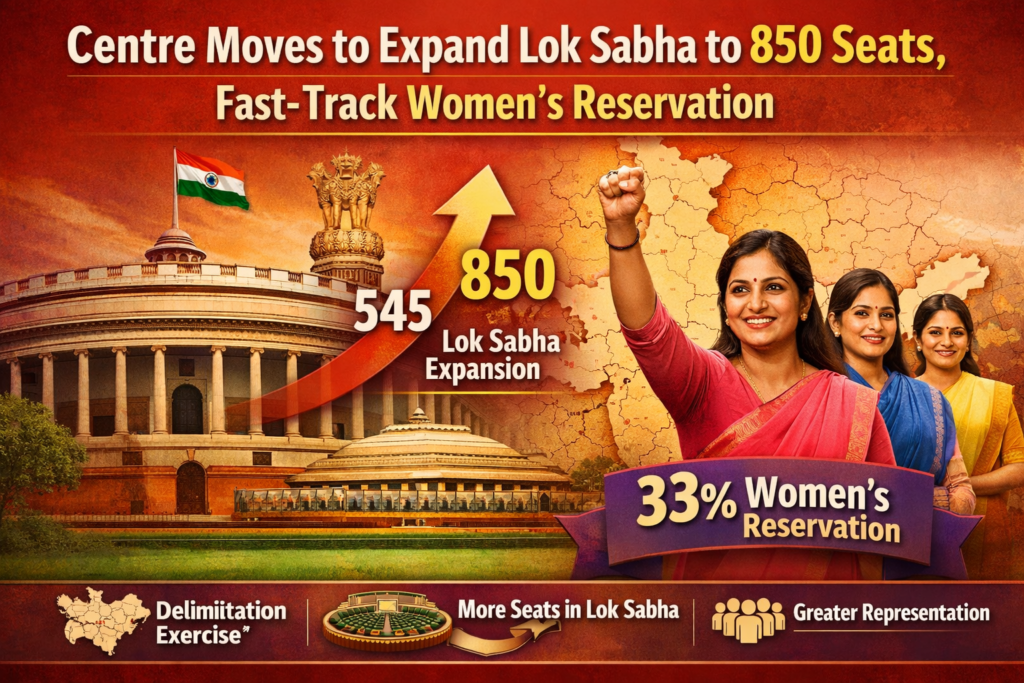
In a major push for electoral reforms, the Union government is preparing to introduce the Constitution (131st Amendment) Bill, 2026 in Parliament, proposing a significant expansion of the Lok Sabha’s strength from 543 elected members to up to 850 seats.
The draft legislation, shared with Members of Parliament on Tuesday, is closely tied to the implementation of 33% reservation for women and a long-pending delimitation exercise aimed at redrawing constituency boundaries based on updated population data.
What the Bill Proposes
According to sources, the proposed amendment seeks to:
Increase Lok Sabha strength to a maximum of 850 members, including representation from states and Union Territories.
Amend key constitutional provisions to enable fresh delimitation.
Lift the decades-old freeze on seat redistribution.
Facilitate early implementation of women’s reservation in Parliament and state assemblies.
If passed, the expanded House could see over 270 women MPs, marking a historic shift in gender representation in Indian politics.
Link to Women’s Reservation
The move builds upon the women’s reservation law passed in 2023, which guarantees one-third reservation for women in legislatures but ties its implementation to delimitation after the next Census.
With the new amendment, the government aims to accelerate that timeline, ensuring that reservation comes into effect soon after constituencies are reorganized.
Why Delimitation Matters
Delimitation is the process of redrawing electoral constituencies to reflect population changes. India’s current seat distribution is largely based on the 1971 Census, due to a freeze imposed to encourage population control.
The proposed bill would pave the way for a new Delimitation Commission, likely chaired by a Supreme Court judge, to carry out this exercise transparently.
Political Implications
While the reform is being positioned as a step toward greater representation and inclusivity, it has also triggered debate across political circles.
Leaders from several southern states have expressed concerns that population-based seat redistribution may disproportionately benefit northern states, potentially altering the federal balance.
The bill is expected to be introduced in a special parliamentary session this week, with indications that it could be taken up for passage in the Lok Sabha as early as Thursday.
If cleared, it would mark one of the most significant constitutional reforms in decades reshaping India’s electoral map and potentially redefining representation ahead of the next general elections.
A Structural Reset in the Making
By combining seat expansion, delimitation, and women’s reservation, the Centre is attempting a comprehensive overhaul of India’s legislative framework.
If implemented as planned, the reform could not only increase representation in the world’s largest democracy but also ensure that women play a far greater role in shaping India’s political future.