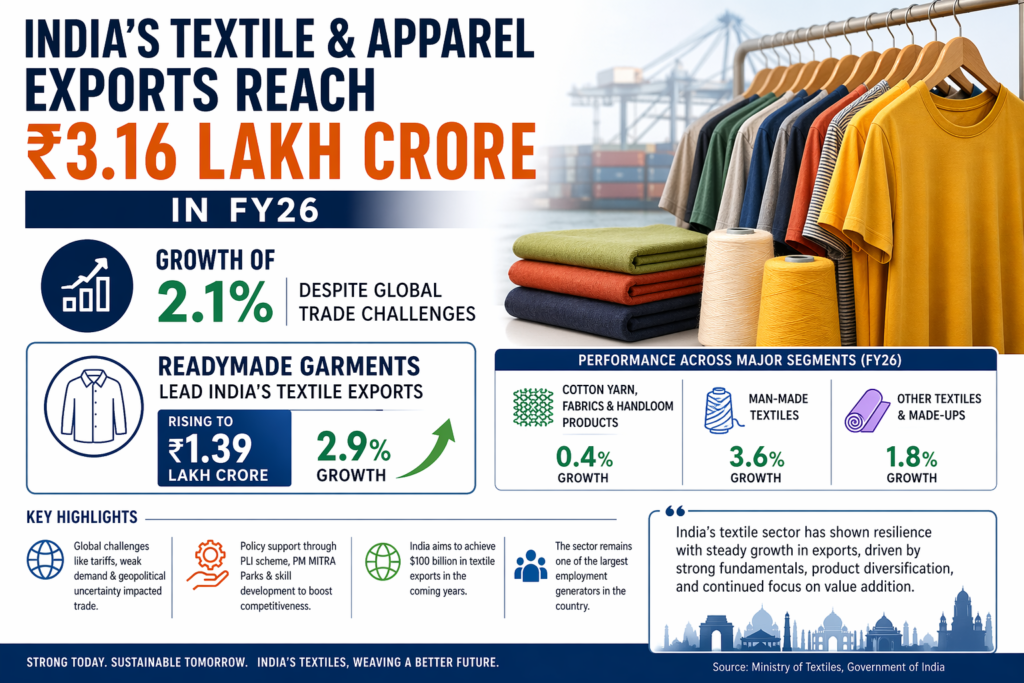
India’s textile and apparel sector demonstrated steady resilience in the face of global economic uncertainty, with total exports rising to ₹3.16 lakh crore in FY 2025–26, registering a 2.1% growth year-on-year, according to official data.
Despite headwinds such as geopolitical tensions, fluctuating demand in key markets, and tariff-related pressures, the sector managed to sustain growth, underlining its importance as one of India’s largest employment-generating industries and a key contributor to exports.
Readymade Garments Lead the Growth
The readymade garments (RMG) segment continued to dominate India’s textile export basket. Exports in this category rose 2.9% to ₹1.39 lakh crore, maintaining its position as the largest contributor.
RMG accounts for a significant share of India’s textile exports due to strong global demand for value-added apparel and India’s competitive advantage in labor-intensive manufacturing.
Mixed Performance Across Segments
Other segments showed varied trends during the fiscal year:
Cotton yarn, fabrics, and handloom products recorded modest growth of 0.4%, indicating stable but subdued demand.
Man-made textiles emerged as a relatively strong performer, growing 3.6%, supported by rising global demand for synthetic and performance fabrics.
This diversified performance highlights a gradual shift in global demand patterns, with increased traction for man-made and technical textiles.
Global Challenges Continue to Impact Sector
The growth comes amid a challenging global trade environment. Rising protectionism, tariff barriers particularly in markets like the United States and slowing demand in major economies have weighed on labour-intensive exports, including textiles.
Monthly data also showed volatility, with exports witnessing periodic declines during FY26 due to weak international demand and pricing pressures.
However, India’s textile sector has managed to remain competitive due to its diversified export basket and cost advantages.
Policy Support and Industry Outlook
Government initiatives such as the Production Linked Incentive (PLI) scheme, PM MITRA textile parks, and skill development programmes are aimed at boosting manufacturing efficiency and export competitiveness.
India currently accounts for a notable share of global textile trade and is targeting significant expansion, with ambitions to reach $100 billion in textile exports in the coming years.
While growth in FY26 remained modest, the textile sector’s ability to expand exports amid global disruptions reflects underlying strength. With continued policy support, diversification into man-made and technical textiles, and improving trade partnerships, India’s textile industry is expected to maintain a stable growth trajectory in the coming years.