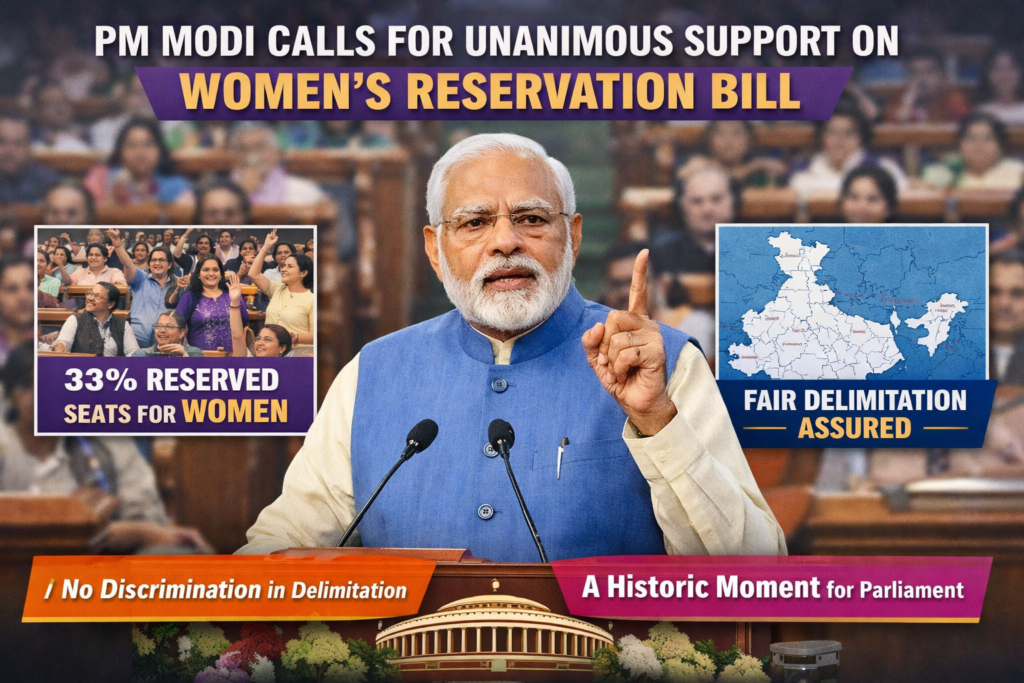
Prime Minister Narendra Modi urged all political parties to extend unanimous support to the proposed Constitution (131st Amendment) Bill, asserting that the upcoming delimitation exercise will be conducted without any discrimination and in the broader national interest.
Addressing the Lok Sabha during an ongoing special session, the Prime Minister acknowledged concerns raised by members across parties but emphasized the historic nature of the legislation. He said the government would respond to all specific issues in detail, while urging lawmakers to focus on the larger objective of strengthening India’s democratic framework.
“There are some important moments in the life of a country… such moments must be turned into a lasting legacy,” he said, describing the bill as one such defining opportunity.
No Discrimination in Delimitation
A key concern among opposition parties and several states has been the proposed delimitation process redrawing of parliamentary constituencies based on population changes. Addressing these apprehensions, Modi assured the House that the exercise would be fair and balanced.
He reiterated that no state or region would face injustice, attempting to allay fears, particularly from southern states that worry about losing political representation due to population-based seat allocation.
Push for Women’s Reservation
The Constitution (131st Amendment) Bill is aimed at operationalising 33% reservation for women in the Lok Sabha and state assemblies, building on the earlier Nari Shakti Vandan Adhiniyam. The current amendment seeks to accelerate implementation by restructuring the linkage between reservation and delimitation.
Government proposals indicate a significant expansion in the size of the Lok Sabha potentially up to around 850 seats with roughly one-third reserved for women.
Modi framed the move as a transformative step toward gender equality in politics, stressing that increasing women’s participation would strengthen governance and decision-making.
Call for Political Unity
In a notable appeal, the Prime Minister called on opposition parties to rise above political differences and support the legislation unanimously. He described the reform as a “national moment” that should not be viewed through a partisan lens.
Reports suggest the government is actively seeking broader consensus, as constitutional amendments require a special majority in Parliament and ratification by at least half of the states.
Opposition Concerns Persist
Despite broad support for women’s reservation in principle, opposition parties have raised concerns over the timing and structure of the reforms. Critics argue that linking the reservation rollout with delimitation could delay implementation and potentially alter electoral balances.
Some leaders have also questioned whether the exercise, if based on population, may disproportionately benefit certain regions over others.
A Defining Parliamentary Moment
Framing the debate in historical terms, Modi said such legislative moments define the trajectory of a nation’s democratic journey. He urged lawmakers to seize the opportunity to create a lasting institutional legacy that ensures inclusive representation.
The ongoing debate in Parliament is expected to culminate in a crucial vote, which could reshape India’s electoral landscape and significantly increase women’s participation in politics ahead of future elections.